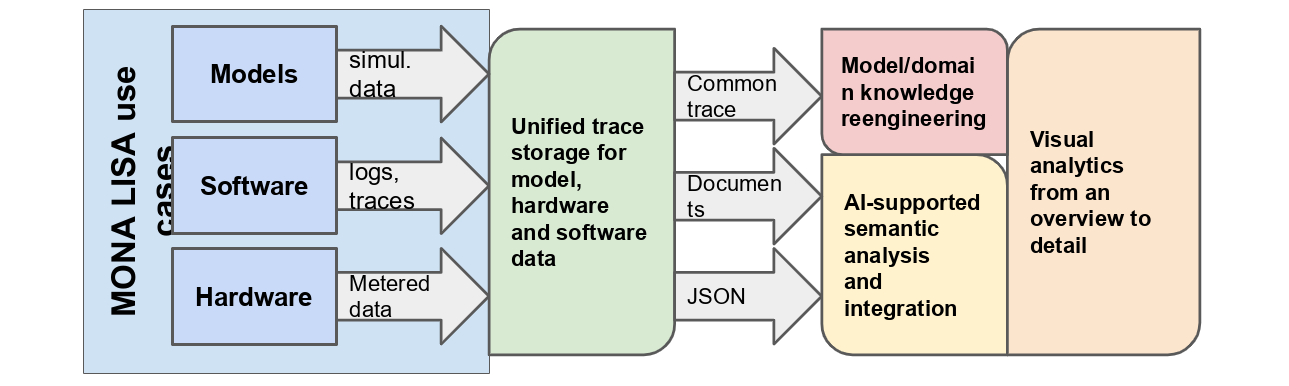
The industrial use cases provide three kinds of data: simulation data from models, logs and traces from software, and metered data from hardware. MONA LISA brings this data together and makes it usable across the lifecycle, from early design to operation and maintenance.
- Unified trace storage. Data from models, hardware and software is stored in one place and converted to a common trace format, the Google Trace Event Format, so that all tools can work on it.
- Model and domain knowledge re-engineering. Models of the system behaviour are reconstructed from trace logs with algorithmic and machine-learning methods.
- AI-supported semantic analysis and integration. Large language models connect documents such as requirements, designs and test reports with the run-time data, supporting root cause analysis and predictive analytics.
- Visual analytics. The results are presented to engineers, who can explore them from an overview down to the details.